
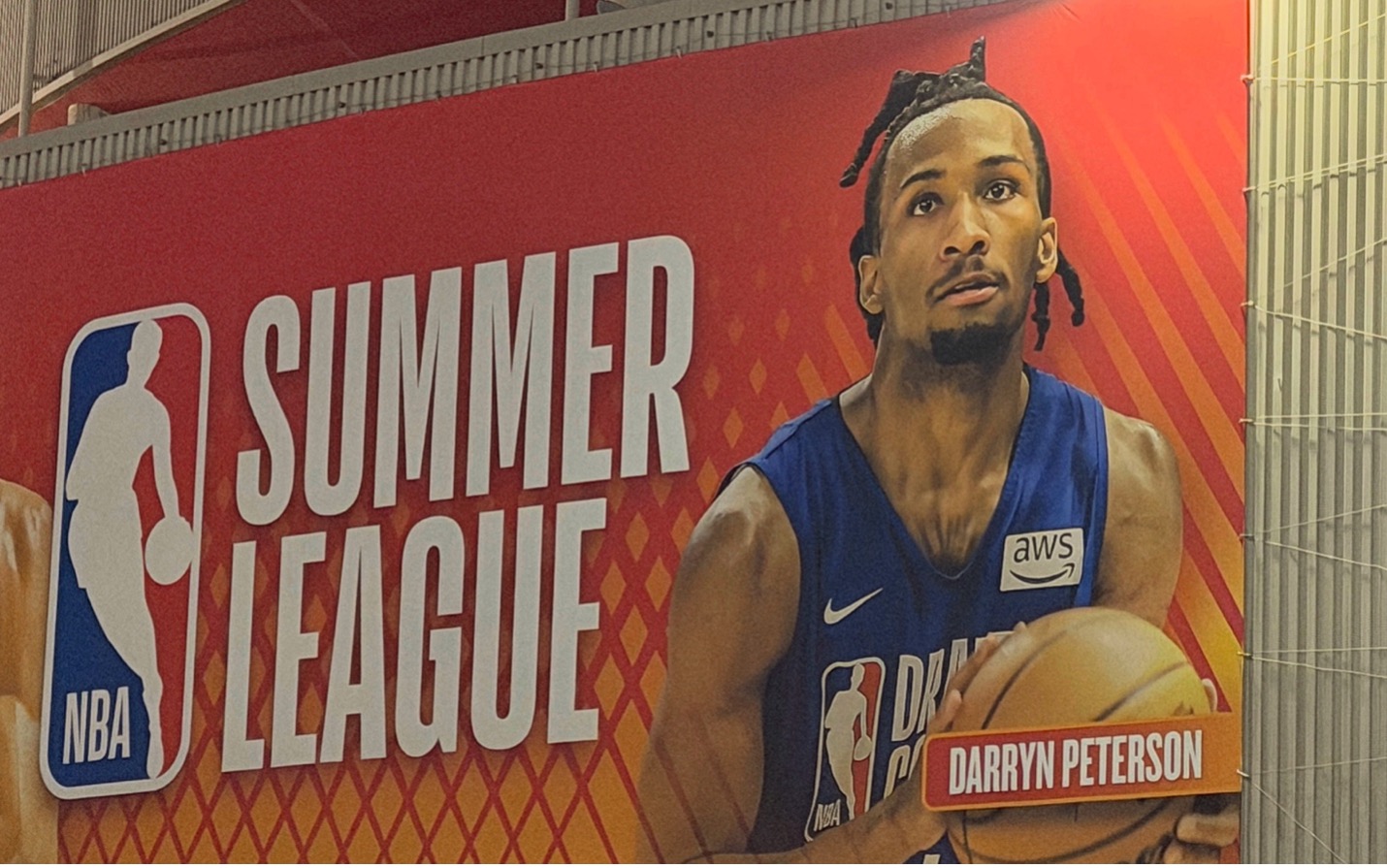
Eleven days in July at the Thomas & Mack Center have quietly become one of the most instructive activation environments in American sport. Here's what worked, and why the rest of the industry should be paying attention.
There is a version of the NBA Summer League that exists in the public imagination: a low-stakes exhibition in a college gym, half-empty stands, rookies finding their feet in front of scouts and diehards.
That version is now several years out of date.
The 2026 edition, held July 9–19 at the Thomas & Mack Center and Cox Pavilion on the UNLV campus, drew more than 156,000 attendees — a 12% increase on the previous record, which had stood since 2018. The championship game, in which the Golden State Warriors edged the Memphis Grizzlies behind eventual MVP Yaxel Lendeborg, averaged 676,000 viewers on ESPN. That is the largest Summer League final audience since 2017 and a 61% jump on 2025. Merchandise sales set a record too, up 11% on the previous high from 2024.
Those numbers matter, but they are not the interesting part. The interesting part is what brands did with them.
Why July in Las Vegas became a sponsorship venue
Summer League has evolved into something the sports calendar does not otherwise offer: a dense, low-friction, high-tolerance environment where the entire industry is in one zip code at the same time.
Every NBA front office is there. So are team trainers, performance staff, equipment managers, agents, media, and an increasingly international contingent of scouts and federation officials. The basketball is the reason for the gathering, not the point of it.
For a brand, that concentration changes the arithmetic. During the regular season, reaching a decision-maker inside an NBA organization means a scheduled meeting, a flight and a narrow window. In Vegas in July, that same person is walking past your activation on the way to a game they are only half-watching.
The stakes are low, which is precisely what makes it work. Nobody is protecting a championship narrative in mid-July. Teams experiment. Brands experiment. Failure costs very little.
Three layers of activation
What played out across the eleven days broke cleanly into three tiers, and the distinctions are worth naming because most brands only ever operate in the first.
The visibility layer. 2K holds naming rights, and the execution is thorough — center-court branding, courtside signage, presence in the official app, and LED placements running along the Strip well beyond the arena footprint. DoorDash attached itself to the Official Ticket Packages sold through NBA Experiences, putting the brand at the point of purchase rather than the point of consumption.
This is classic, competent sponsorship. It buys impressions and it buys association. What it does not do, on its own, is generate a conversation.
The Tech Expo is the story
Tucked into a practice gym beside the Thomas & Mack Center, the NBA Tech Expo assembled 35 companies showing everything from coaching tools and protective equipment to biomechanics and player tracking. Alan Snel of LVSportsBiz described it as the NBA's own mini-CES, which is about right. It is also, functionally, a hosted buyer environment — even if nobody calls it that.
Consider the moment Snel captured: Kevin Gehsmann, the 30-year-old co-founder and CEO of PROTECT3D, mid-conversation with a reporter, politely breaking off because a Houston Rockets trainer had stopped at his table. PROTECT3D makes protective face masks; Jaylen Brown has worn one, as has the Aces' Jewell Loyd. That interruption is the entire value proposition of the format. The buyer came to him.
Five of the 35 exhibitors were selected for the NBA's Launchpad program, chosen from more than 200 applicants, and presented at a demo event during the week. Across five years, Launchpad has backed 27 startups.
The compounding effect is measurable. BetterGuards, a Launchpad selection in 2023, now supplies its ankle brace to players on all 30 NBA teams and employs 110 people. CEO Tony Verutti told LVSportsBiz that revenue has grown tenfold since the program. "It was important for the journey," he said. "It helped unlock our potential."
That is not an impressions number. That is a business outcome traceable to a room.
What this signals
The lesson of Summer League 2026 is not that brands should buy more signage. It is that proximity to qualified decision-makers, in a setting with low stakes and high tolerance for experimentation, produces commercial outcomes that broadcast exposure cannot.
The sports industry has understood the value of the sponsorship dollar for decades. What it has been slower to build is infrastructure for the meeting — the deliberate, pre-arranged conversation between someone with a budget and someone with a solution.
Summer League backed into that infrastructure almost by accident, through a practice gym full of startups and a demo night in a meeting room. The results speak for themselves.